50 km south of Nuuk, on a tranquil arm of the fjord, the gouged-out metal hulls reflect an impassive light. We switch off the sailboat’s engine; now only the lapping of the water against the bow breaks the silence. The impression of stepping into a post-apocalyptic film set is immediate – but the story that lies behind these ruined facades is very real indeed.
A Faroese outpost at the end of the world
It all began in 1927 when fishermen from the Faroe Islands were granted permission to establish a shelter harbour in this sheltered fjord. They named the site Føroyingahavnin (‘Faroese harbour’), which soon became known by its Danish name, Færingehavn, or its Greenlandic name, Kangerluarsoruseq.
In 1953, the alliance between Norway, Denmark and the Faroe Islands – known as NORDAFAR – transformed the simple landing stage into an industrial complex: mechanical workshops, a power station, a hospital, a cinema and, above all, a gigantic filleting plant that would make the site Greenland’s largest seafood processing facility in the 1960s.
The golden age of the ‘kingdom of cod’
At the height of its prosperity, a fleet of Faroese trawlers unloaded thousands of tonnes of Atlantic cod here. Hundreds of workers – seasonal seamen as well as families living here year-round – lived in the colourful barracks, bought their groceries at the ‘Shop’, had their laundry done at the communal washhouse, or gathered for a film screening at the Norwegian Welfare House. Life was hard, but money from the fish trade flowed freely. The antiques still scattered throughout the buildings – an old snowmobile, a broken piano, packets of Aalborg Akvavit – bear witness to that bygone way of life.
When the sea runs dry, the village dies
From the 1970s onwards, catch figures took a sharp downturn; industrial overfishing, cooling waters and changes in ocean currents caused cod stocks to plummet along the entire north-western Atlantic coast. NORDAFAR did attempt a rapid switch to shrimp fishing, but competition from other, better-equipped ports doomed the venture. The factory closed its doors in 1985, the company was declared bankrupt in 1989, and already the wind was whistling through the corrugated iron roofs.
One last winter, then silence
Deprived of work and services, families set off for Nuuk or returned to the Faroe Islands. A few maintenance workers still managed to scrape by until the late 1990s, but the last resident left Kangerluarsoruseq in 2009, sealing its fate once and for all as an Arctic ‘ghost town’.
Visiting today: a mix of thrill and respect
Approaching Kangerluarsoruseq by sea is like crossing an invisible barrier between two eras that no longer communicate. The fjord slowly closes in behind the boat, and already the world of the past seems to be receding.
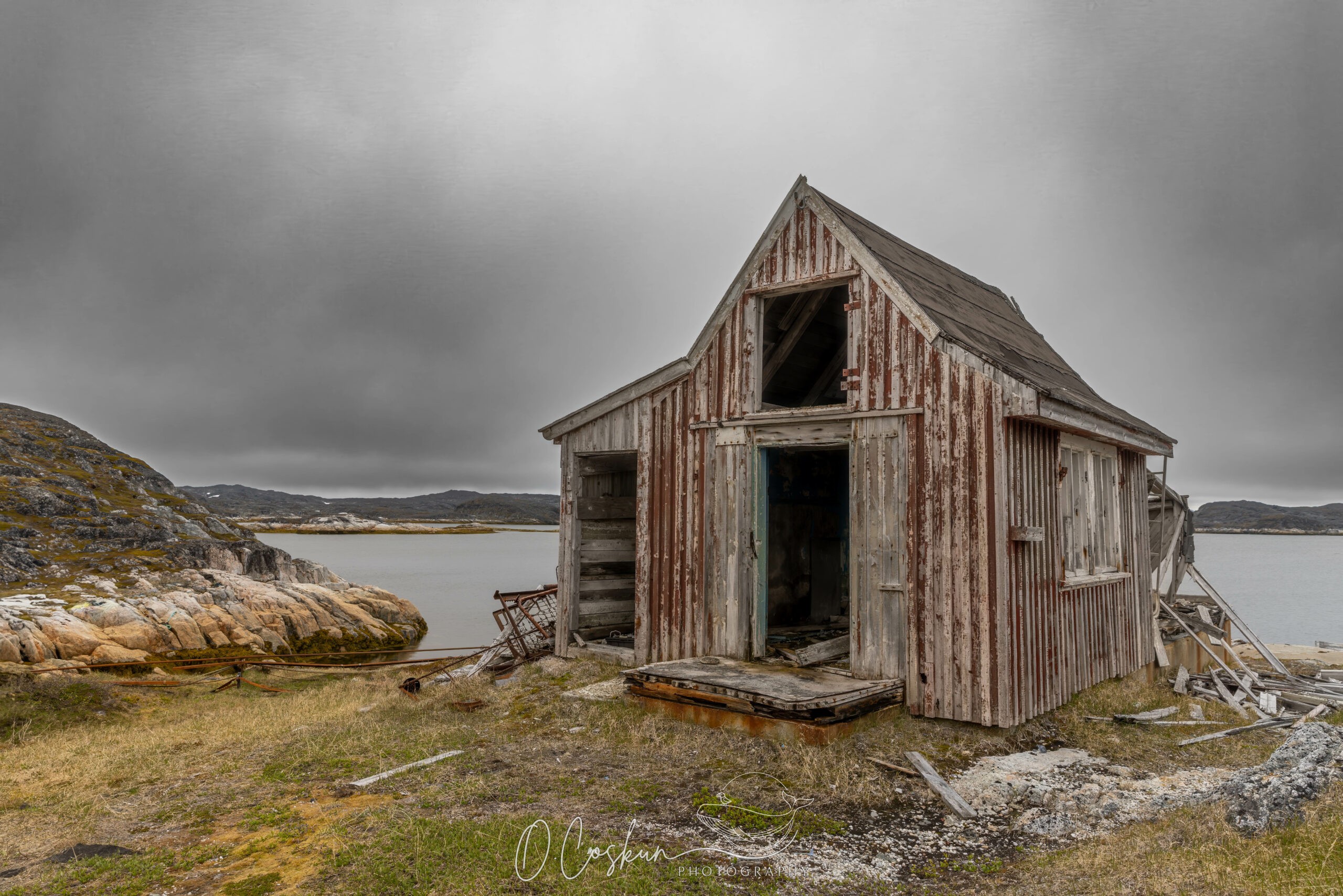
The jetty, worn away by successive winters, now offers only an uncertain, almost hesitant mooring, as if the land itself were refusing to welcome visitors any longer. The wooden and metal structures, corroded by salt and frost, bend silently under the weight of the years.
Further on, the gaping warehouses lay bare their innards to the void: in the damp twilight, one can still make out the remnants of a vanished industrial order — motionless conveyor belts, cold stores opening out onto nothingness, Nordic pine frames blackened by time, suspended like skeletons in the salty air.
And everywhere, a solitude so dense that it becomes almost tangible. It envelops one’s footsteps, muffles sounds, erases landmarks. Only at moments does it crack: the shrill cry of a fulmar pierces it like a blade, or the furtive glide of an arctic fox between two ruins serves as a reminder that here, despite everything, life has not entirely given up.
An ecological moral beneath the rusted metal
Beyond the strange beauty of the ruins, Kangerluarsoruseq encapsulates, within a few crumbling walls, the entire fate of a single-resource economy: when the sea ran dry, the village ran dry with it.
The breeze grows cooler. The corrugated iron roofs creak one last time, as if to remind us that, unless we learn from past mistakes, history is doomed to repeat itself.
As we leave the fjord, whilst Kangerluarsoruseq slowly fades into the mist, one feels as though an entire world is closing behind us — like a parenthesis abruptly brought to a close. And it becomes difficult not to think, at that moment, of the fragility of the delicate balances that still sustain the lives of Arctic communities today, and of the uncertain rhythm of the oceans, which human activities have gradually thrown out of balance, to the point where their rhythms have become unpredictable.