It was a book that set me on my way. William Dalrymple, Nine Lives, the second chapter—a low-caste barber who becomes a god for one night on the Malabar coast. I had read it as one receives a promise: somewhere in India there existed a ritual in which a man truly became a god. He put on a costume weighing several kilos, covered himself in paint and flowers, and something else entered him.
I wanted to see that. On the internet, my first searches quickly showed their limits: posted timetables, packages, organised groups. I wanted the village Theyyam, the one of the real night.
It was while looking for somewhere to stay, almost by chance, that I found the lead: a review of a small guesthouse of three bungalows in traditional Keralan architecture, near the Adi Kadalayi temple, eight kilometres south of Kannur and five minutes’ walk from Thottada beach. The place was called Costa Malabari and it was run by a certain Mr Kurian. The reviewer added, as if in passing, that Mr Kurian knew his region perfectly and gave excellent advice on how to attend a Theyyam.

I wrote to him on WhatsApp, since that is how everything is done there, explaining that I would be arriving by train after midnight. His reply came quickly, simple and calm: “Don’t worry. I have arranged a riksha to pick you up and bring you to Costa Malabari.”
I hadn’t even left yet, and someone had already thought of me.
The Jan Shatabdi Express (jan means “the people” in Hindi): burgundy vinyl seats, ceiling fans, blue curtains at the windows, and two hundred and eighty kilometres north through the Kerala night. At every stop, vendors climbed aboard with trays of biryani and worked their way down the aisle offering them to the passengers. In India, life never really stops, even at night.
It was past midnight when the train pulled into Kannur station. I had no idea how I would recognise the rickshaw, Mr Kurian’s “riksha”, which had taken me a while to understand. The heat of the day had withdrawn and the night was pleasant. I stepped out onto the forecourt, looked around, and the driver came towards me. I was the only foreigner outside the station: he needed neither a sign nor a name. I got in.
We crossed empty streets. The city was asleep. I felt both lost and detached from everything I knew, from everything that defined me elsewhere, but without any fear. Only that particular lightness you feel at night in an unfamiliar city when you have decided to trust.
When I arrived, it was Mr Kurian’s son who welcomed me. The night, the bungalows, the silence of the village: everything was calm. I only saw Mr Kurian the next morning. He was there, quiet, as if nothing were out of the ordinary: a composed, wise man, not very talkative. He brought out his books and explained Theyyam to me with great precision, without any flourish. His wife came and went in silence. She was the one who cooked, and wonderfully.
I don’t know whether he is still there**.
It was he who found me Praveen Shenoy, a taxi driver native to the region, who knows the temples, the villages and the nights of ceremony the way others know the streets of their own neighbourhood. Without him, I would have wandered down the wrong roads to the wrong places. I called him to ask what the possibilities were. He answered: “Let me check.”
Then, a little later: “Tomorrow we need to start at 4 o’clock morning.”
We left at four in the morning. The night was still thick, the roads deserted, and sleeping villages slid past the windows. Praveen drove without hesitation, like someone who knows every stone along the way.
He took me to the Aduthila Guliyanka Bhagavathy temple, at the Aduthila stop on the road from Kannur to Pazhayangadi. It is a family temple, recently renovated, dedicated to the goddess Guliyanka Bhagavathy. Legend has it that, rejected by the Kaalakaatti Illam house, she took refuge at Kallukuthu Kuzhi, then settled nearby, at Aduthila, won over by the manners, discipline and rites of the Poonthottam and Viswakarma priests. On a scrap of paper, someone had noted by hand the Theyyam of the night: Kurathi, Bali, Guliyanka Bhagavathy, Vishnumoorthy, Kunoor Chamundi, Gulikan.
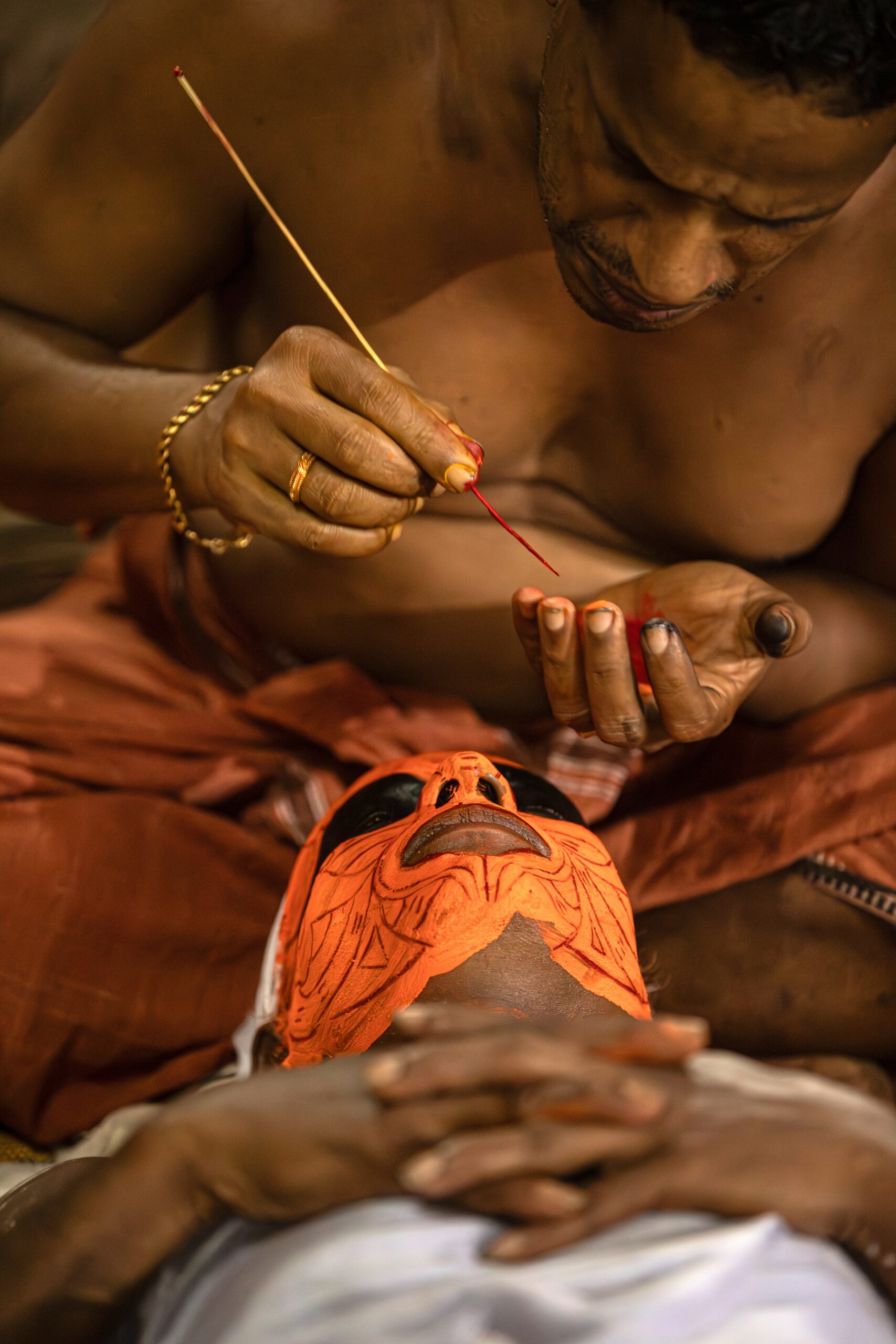
I was able to watch and photograph every stage of the preparation in a small room, as calm as the outside was agitated. On the floor, woven palm leaves. In the centre, a copper bowl where hands with gold bracelets and long black nails tended a tiny flame, with a humble, precise, repeated gesture. The fire stayed there, silent, throughout the transformation.
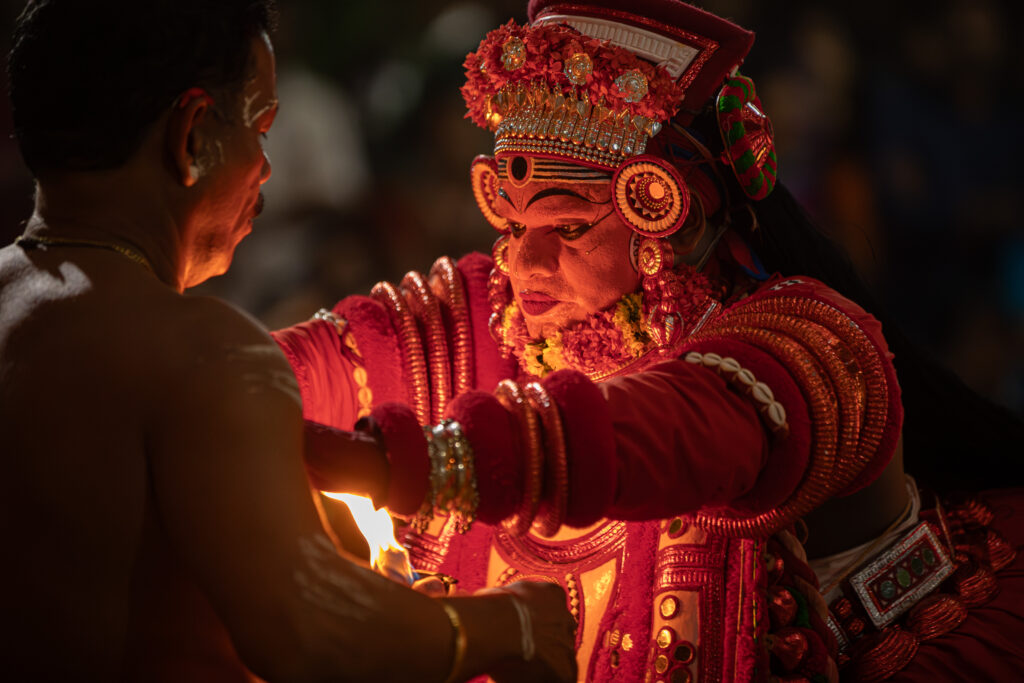
The transformation was slow. The bare face first, then the colour spreading, that vivid orange drawn from turmeric, an ancient plant material. Then the eyes, which change their gaze, the ornaments set on one by one, and last of all the monumental headdress, golden, vertiginous, which seemed to carry the weight of another world.
And then, gradually, he became.
Something was entering him slowly, in layers. At what moment had the man yielded his place? I couldn’t have said. Perhaps that is the whole mystery of Theyyam.
Outside, the night was alive: families, children carried on shoulders, people praying. Almost no tourists. When I met someone’s eye, I read curiosity there, perhaps, or a benevolent indifference, never the irritation reserved for an intrusive foreigner.
I photographed quietly. I was the only one doing so: no group, no flash. I had been allowed into that moment as if I were transparent, and I felt it was because I had been accepted.
Between two ceremonies (this was neither the only night nor the only temple), I was offered food and drink on a banana leaf, as is the custom. A simple gesture, without comment. I was the foreigner, and yet I was inside the circle.
What I keep from Theyyam is simpler, and stranger, than the monumental headdress or the torches in the night, even if those images remain engraved in me.
A man lying on a mat in front of the temple, worn out by the long night, with four children pressed against him looking at their phones in the morning light. The age-old rite and the screen, with nobody seeing any contradiction.
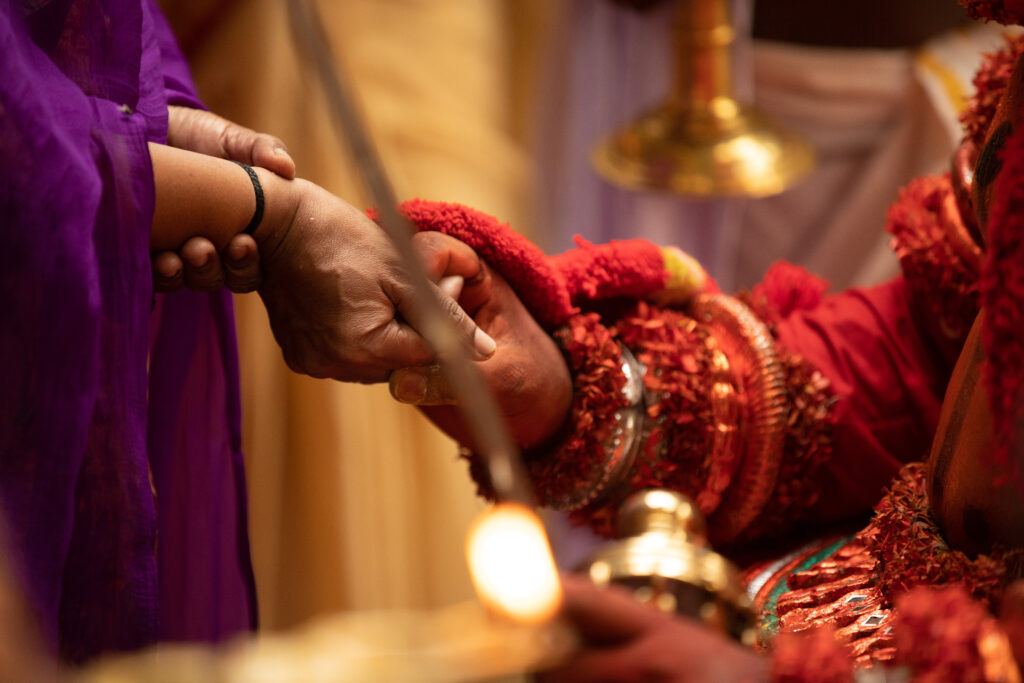
A woman in a purple sari holding the hand of the deity, adorned with red flowers and bracelets, red and gold. A tender, almost ordinary gesture, except that it is the hand of a god she is holding.
The orange of the turmeric, the flame in the copper bowl, the crowd praying in the night: all of it formed something I couldn’t name exactly. A space where a mortal becomes a deity in everyone’s eyes, and where everyone believes it, the way one believes in something true.
I was the foreigner and I did not share their faith. But I had been there, a transparent witness, in that Kerala night where the boundary between man and god had dissolved for the length of a dawn.
** I learned recently from Christophe Boisvieux, who knew him very well, that Mr Kurian has passed away. May he rest in peace.