The Theyyam had captivated me with its slowness — the turmeric spread across a face, the headdress being fitted piece by piece, hours before the man finally stepped aside. As for the Kambala, I sought it out without realising I was seeking its opposite.
My internet searches led to one name: Dr Krishna Mohan, a surgeon in Moodubidire, an amateur photographer, and the moderator of a photography critique forum. A website and seven social media accounts listed in his signature. I wrote to him asking for a schedule of performances. He replied — not straight away, not even once. Several exchanges, spread over weeks, until that final email in which he sent me the dates, “vastly altered from the earlier dates”, as if even the local organising committee was struggling to keep track of things. “Thanks for contacting me :)”, he wrote every time. A stranger who was taking the time, for someone he would never meet, thousands of kilometres away.
The itinerary led to Baradi Beedu. All that remained was the logistics: Chethana Travels, a taxi hired for the day, a return journey from Mangalore railway station. “Sure will arrange the cab.” The same calm as elsewhere in India, that sense of certainty that leaves no room for discussion.
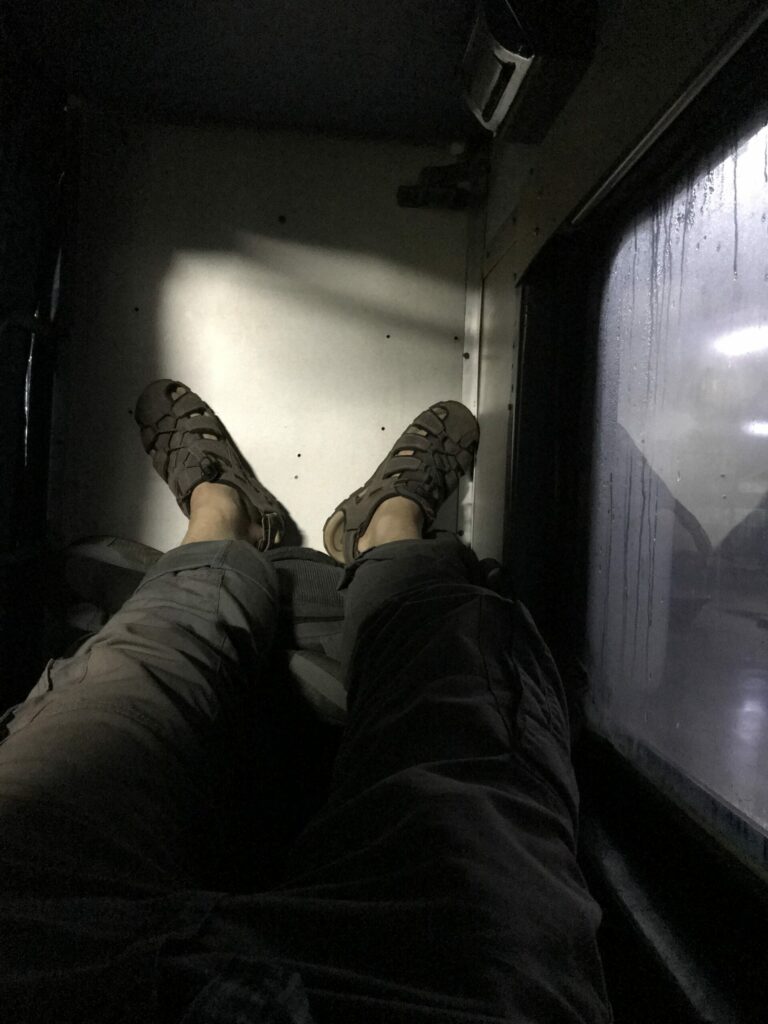
I’d just arrived from Kannur, where the Theyyam had kept me occupied the day before. We set off at dawn, my feet propped against the side of a sleeper compartment, the window streaked with rain, a curtain in place of a door. Mangalore Central at 8.17 am — a platform still half-asleep, a few figures on the iron benches, a train standing under the glass canopy. There was no hint of what was to follow.
The driver was waiting for me, but clearly hadn’t really looked at the route. He asked some colleagues for directions, then we set off. A stop to get some water. It had been a short night; I dozed off for the rest of the journey, without retaining any clear images — just that sensation of floating between two worlds whilst I was being driven towards the next one.
And then a crowd, appearing out of nowhere.
Baradi Beedu, seen from the air, is nothing more than a gap in the canopy — a dual-lane track surrounded by coconut palms, with no main road nearby. No infrastructure for a spectacle. And yet, on that day, hundreds of men were converging there, via dirt tracks barely visible on a satellite map. Not a single tourist. I was the only Westerner — but I wasn’t a spectacle in my own right. The spectacle itself was far more interesting than I was.
The canal stretched out, its terracotta-coloured water flanked by two banks of compacted mud. A human barrier on either side, held in place by a simple rope. And then the buffaloes would burst into view — two animals yoked together, their horns adorned with flowers, the jockey standing on his board behind them, leaning forward, bare-chested, wearing a red headband, a riding crop or a stick in his hand. The speed, the splashing, the dull thud of hooves in the water.
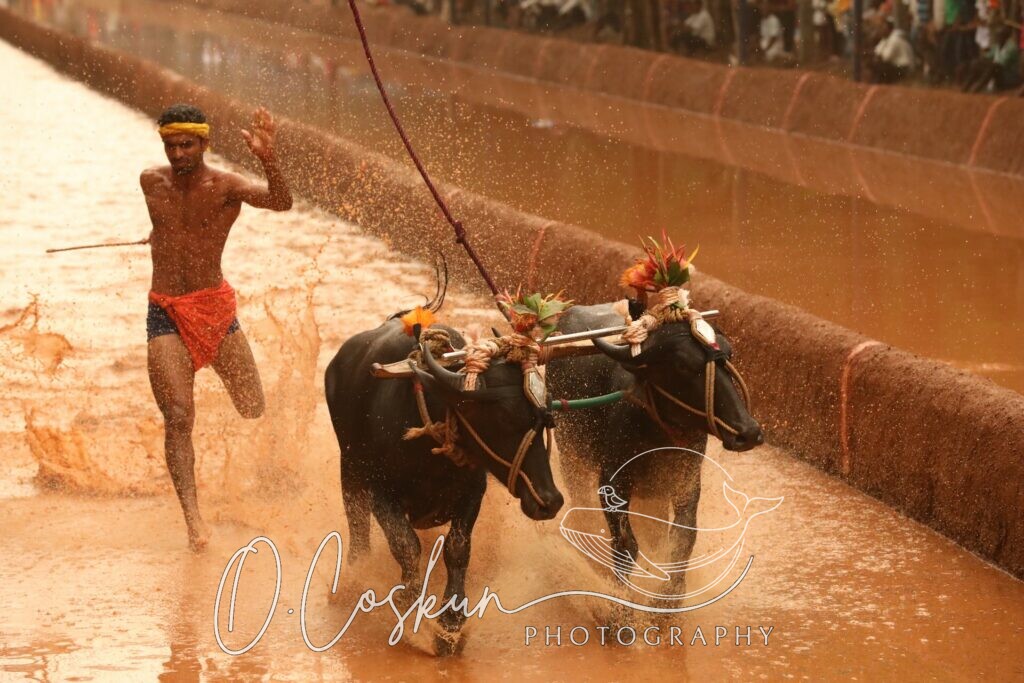
It was precisely this speed that astounded me. Not all the animals were the same — I saw small buffaloes led by very young jockeys, then, as evening fell, large animals harnessed to a cart. But their size mattered little: some teams raced off so fast that the man behind could no longer keep up — the board slipped from his grasp, his hands let go of the reins, and the buffaloes finished their race on their own, without a jockey, leaving behind the silhouette of a man standing in the water, overtaken by what he had just set in motion. I would later learn that a runner from the region had once run fast enough to be seriously compared to Usain Bolt. At the time, I didn’t need any records to understand: these beasts were faster than the men supposed to be leading them.
At the exit of the canal, on dry land, things got complicated. The buffaloes had no predictable path once they were released from the water — a team in yellow stood ready to intercept them, but the rest of the crowd was retreating into the dust with a mixture of haste and familiarity, without anyone ever really knowing where the animals would come to a halt. India, my driver seemed to be saying without actually saying so: the organisation sometimes leaves something to be desired. And yet everything was working, in its own way.
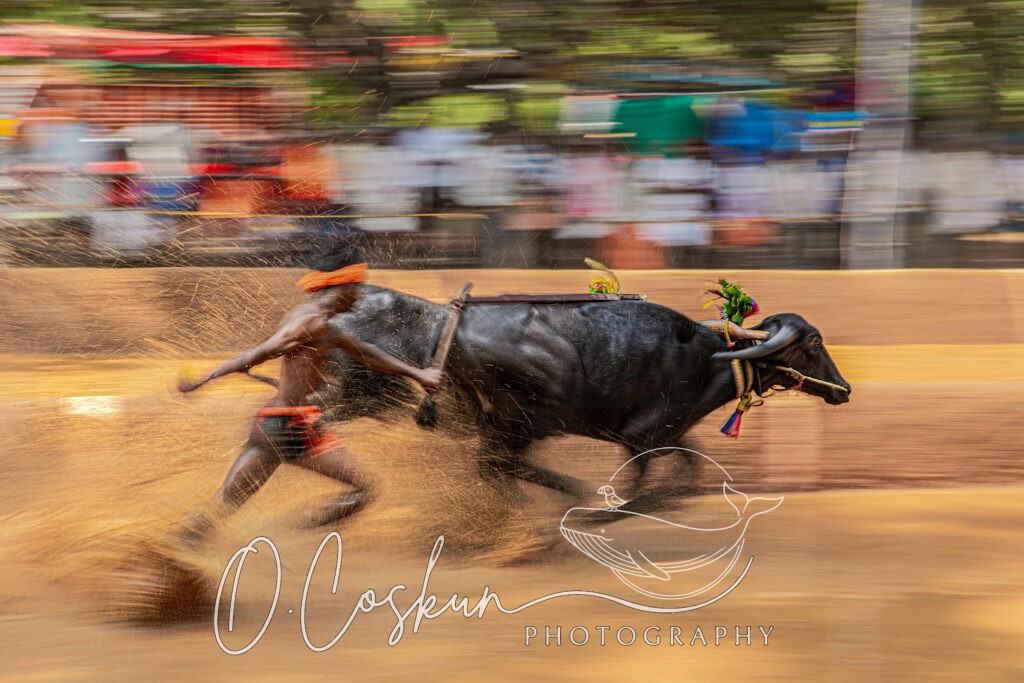
Local photographers would come and see me between jobs. They’d show me their pictures on their camera screens — and it was one of them who gave me the idea for the panning shot, a technique I’d never tried before: keeping the buffalo in focus whilst letting the background blur into streaks of motion. A spontaneous exchange between strangers who shared the same passion for photography.
Across the canal, another scene was unfolding — teams of men washing the buffaloes and preparing them between runs. A proper sporting organisation, complete with its own support staff and rituals, invisible from the track itself.
Around 1 pm, tiredness finally got the better of my excitement. It had been a short night, and the morning had started early with the photography — I found a patch of grass and ate my biscuits. When I stood up, my foot and ankle were covered in red bites. I never found out what had bitten me like that, silently, whilst I was eating.
Dusk was falling when I had to go and look for my driver — hired for the day, with no organised taxi service behind him, just a mobile number as a safety net. Amidst a crowd as dense as the one that morning, I wasn’t feeling at ease. There he was, quietly eating on the go — street food that I, for my part, have never fully trusted in India — or anywhere else for that matter.
Back to Mangalore, then Ernakulam, on the NZM TVC SF Express, after midnight — a train that runs from Hazrat Nizamuddin in New Delhi to Thiruvananthapuram, in the very south of Kerala. I was only taking a small part of it, a few hours in the middle of a journey that crosses almost the entire subcontinent. The journey came full circle near Kochi, the starting point and destination of a week that had taken me north twice and south twice — first the backwaters and tea plantations, then Theyyam, then Kambala, two worlds traversed a day apart, within the same Kerala, the same coastal Karnataka.
Years later, whilst looking through my photos of Kambala, a doubt crept in. Had I even thanked Krishna Mohan? I searched through my emails. No — nothing. Five exchanges between us, spread over several weeks, and not a single line of thanks from me once the trip was over.
I wanted to put things right, albeit belatedly. I found his photography website, still online, with the same email address in his signature. And whilst checking that it was all still there, I came across an article: Dr Krishna Mohan Prabhu, a surgeon in Moodubidire, known as “Krishi”, a naturalist and keen trekker and photographer, had died of acute leukaemia at the age of 55, shortly after our exchange.
I never met him. I didn’t know him. But he had taken the time — several times, patiently — for a stranger thousands of kilometres away who was simply asking for a calendar of buffalo races.
It broke my heart. I didn’t know him, I’ll never see him again — and yet, despite his absence, I still feel a gratitude towards him that I was unable to express to him in time.