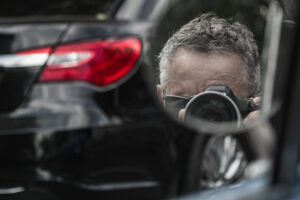
Robert Capa used to say that if your photos aren’t good enough, it’s because you weren’t close enough to your subject. I’ve never thought about that quote more than I did that day in Barsana, when a bucket of coloured water hit me right in the back and, soaked to the bone, I had no choice but to carry on taking photographs.
I hadn’t set off alone this time. Photographes du Monde had organised the trip — with Holi as the overarching subject — and our guide, Christophe Boisvieux, a photographer and specialist in South Asia, knew North India and its countless variations on the festival like few others. It was he who made the wise decision to take us to Barsana and Nandgaon rather than anywhere else: not the touristy Holi of the big cities, but its oldest and most authentic form, that of Braj. No uncertain trail to follow either, no Mr Kurian to contact on WhatsApp — just a group, a calendar, and the promise of two days in the cradle of Krishna.
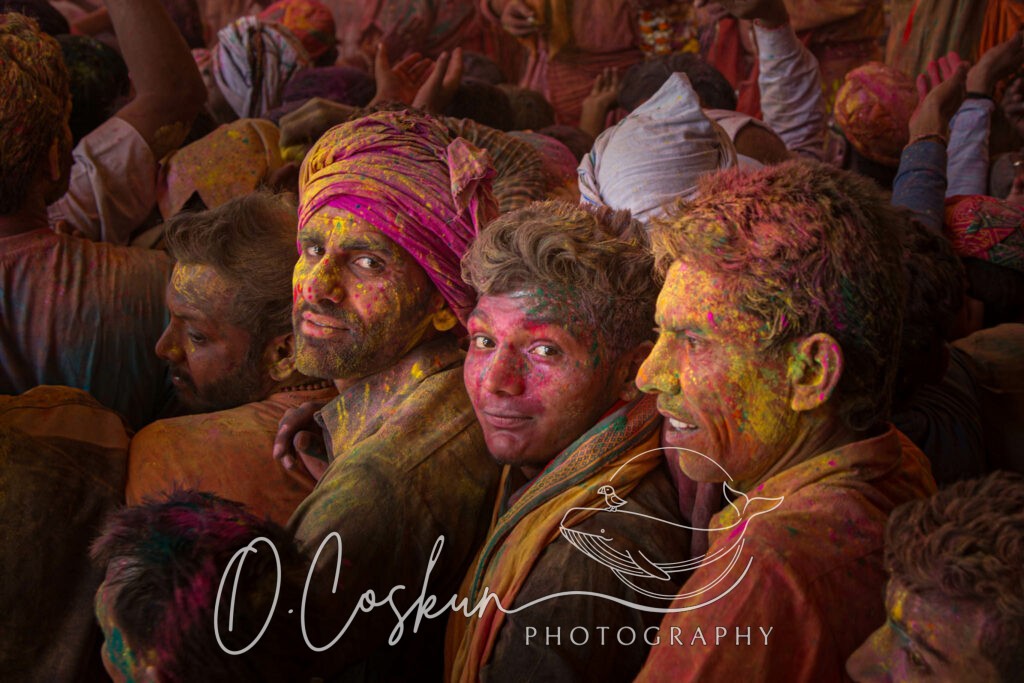
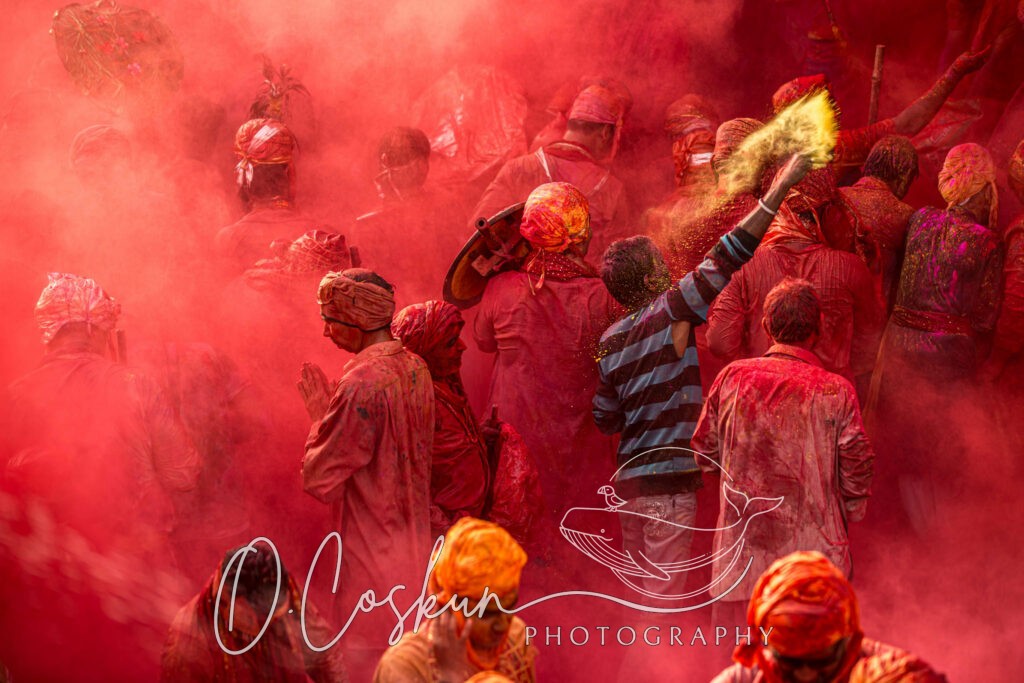
In Barsana, it all began with an entrance I hadn’t chosen. In front of the temple, the crowd had condensed into a single compact mass, and I found myself swept up in it, with no direction of my own — a human river moving forward without my knowing where or when I would end up. On the right, a line of men stretched on and on: they were throwing handful after handful of coloured powder onto this river of people, without aiming at anyone in particular, just for the sake of the gesture and the colour flying through the air.
To breathe normally amidst all that powder, you had to cover your nose and mouth — with a scarf, bought the day before along with the rest: a traditional shirt and trousers, found at a bargain price, which I knew were bound to end up red before the day was out. Christophe had also warned us about our cameras: protect the bodies, wrap up whatever could be wrapped. We’d followed his instructions.
I’d wanted to get a higher vantage point a little earlier. A balcony further on seemed to offer the view I needed — overlooking the scene, unobstructed, with large barrels of coloured water lined up against the balustrade. Together with another photographer from the group, we tried our luck with the police, who were doing their best to keep the crowd at bay, batons in hand themselves. “We’re journalists.” It didn’t work. We were left down below, and we left empty-handed.
It may well have been from that very same balcony, which we’d been denied access to, that the water which soaked me later came from.
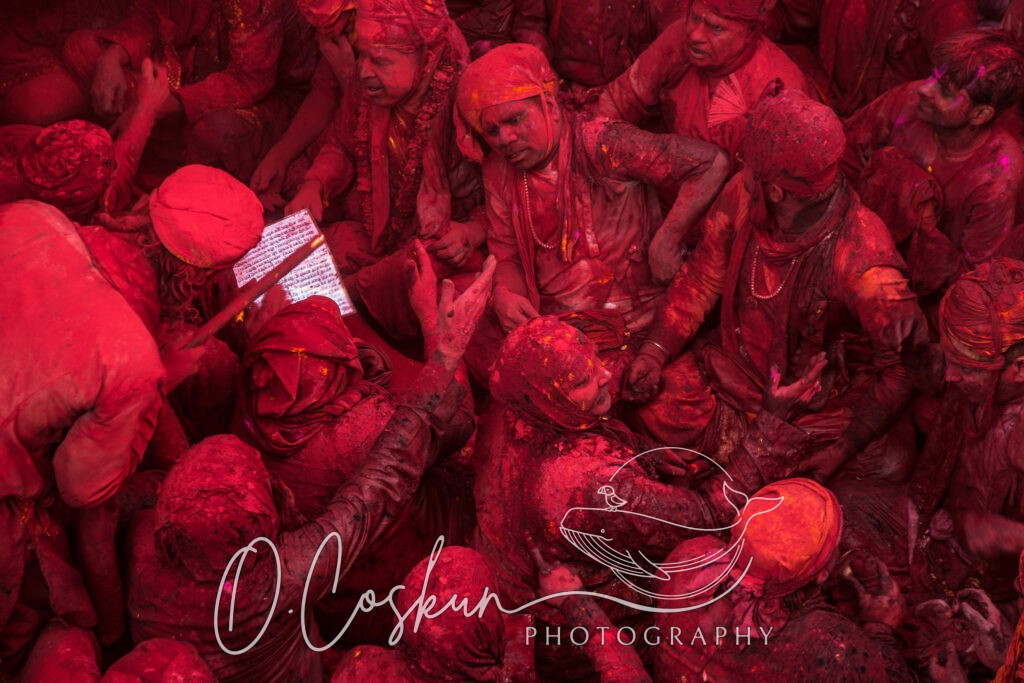
Further back in the throng, a man was holding an open booklet in his hand — a devotional text, no doubt, which others were following with their eyes despite the dust that was already covering the page. Just above him, another man, leaning over him, was holding a walking stick. Around them, dozens of outstretched hands, raised arms, a physical closeness one experiences only at such a moment — pressed up against one another, with no greater distance possible.
It wasn’t enough, despite all the precautions: the bucket hit me squarely in the back, without warning. A shock, a complete surprise. On instinct, I looked for shelter. There was none. So I carried on taking photos, soaked to the skin, with nothing left to lose.
The dust, however, had found its way in despite everything. I’d already noticed it back in India — a fine blue deposit that had seeped into my camera’s viewfinder. There was nothing I could do about it there, other than carry on: luckily, the camera was still working, so I could still take photos. It wasn’t until I got back to France that I realised the extent of the damage, following a visit to Canon and a bill I could well have done without.
The next day, in Nandgaon, the town was once again in a festive mood — but in a different way. The pace seemed slightly less frantic than in Barsana, and above all, this time, the colours weren’t all converging on the same shade of red. Inside the temple, I was able to take lots of portraits, using this much broader palette — yellows, greens, pinks, blues — which contrasted with the almost monochrome jumble of the previous day.
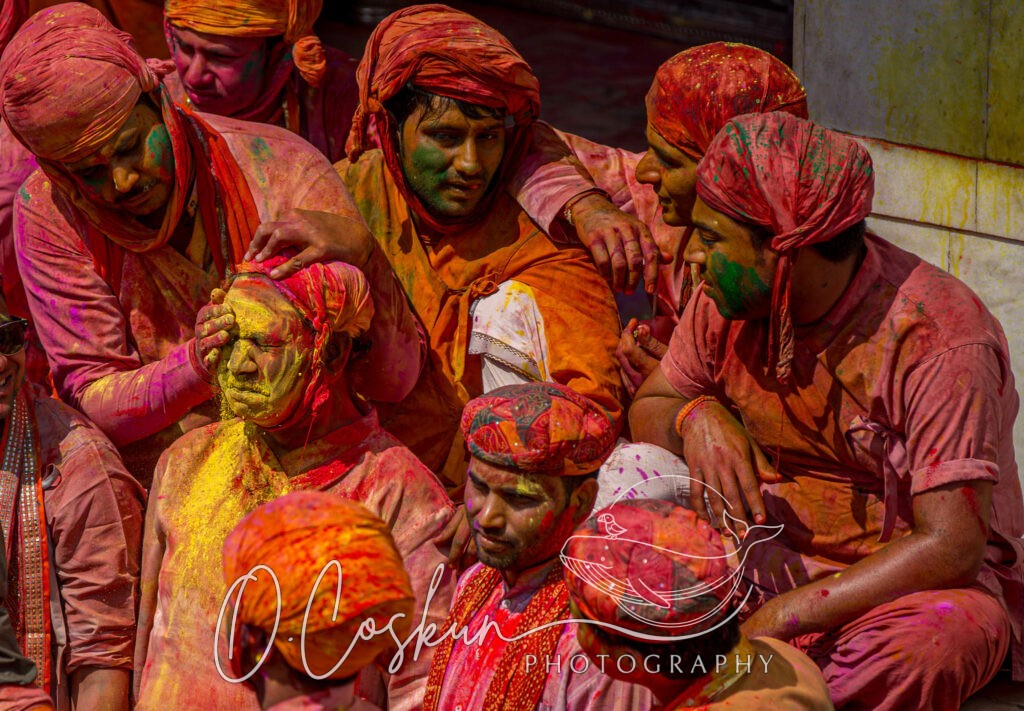
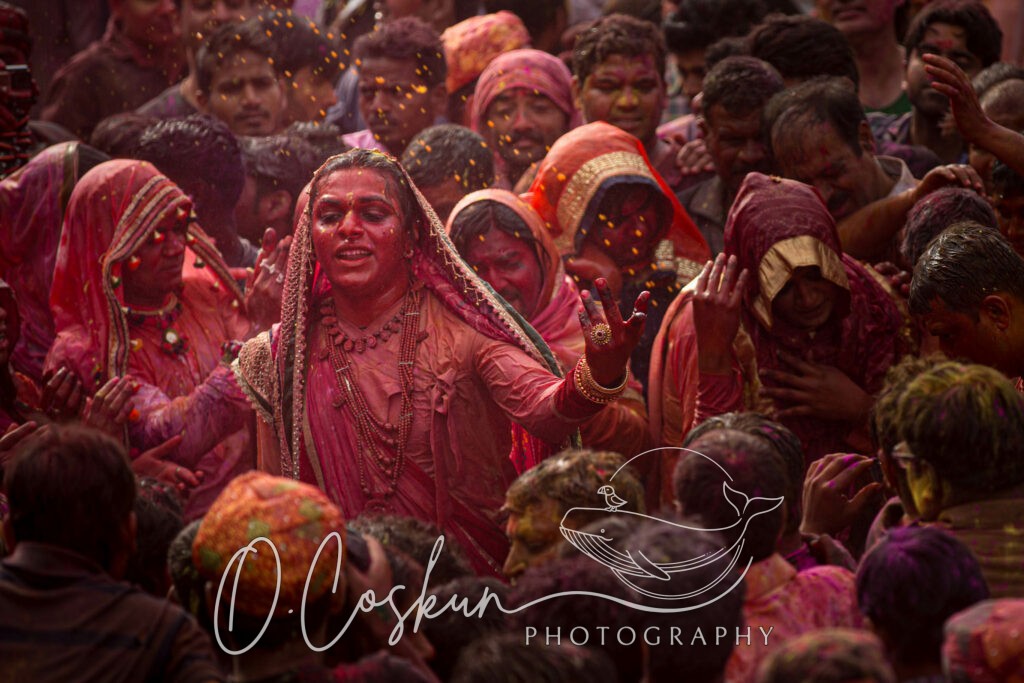
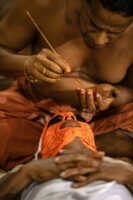
It was there, in the temple, that I came across a different scene: several figures with painted faces, draped in colourful fabrics, dancing amongst the crowd, surrounded by men who were watching them or dancing with them. Hijras, members of this gender-non-binary community, whose religious tradition dates back to the myth of Krishna taking the female form of Mohini — a ritual presence at the Lathmar, where gender boundaries are blurred a second time, after the sticks have already reversed the usual roles between men and women.
After the temple, we made our way into the city. I was trying to find a spot to take photographs, but it wasn’t easy — the crowd was incredible, and I found myself standing in front of a house. On the doorstep, a little boy was watching me. He said to me, ‘Come, come.’ I followed him.
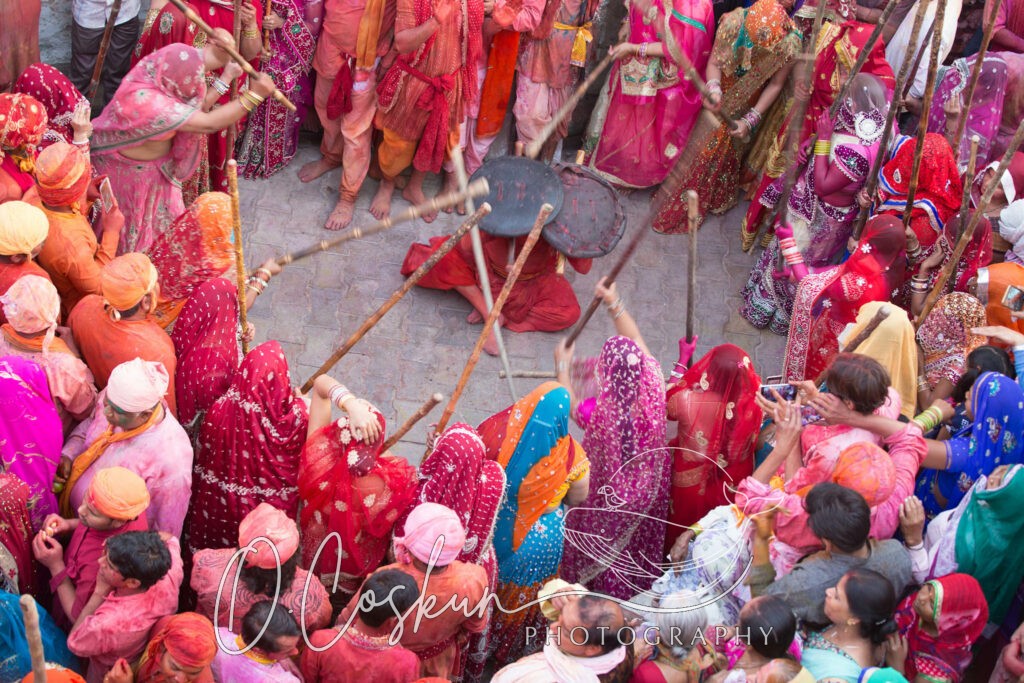
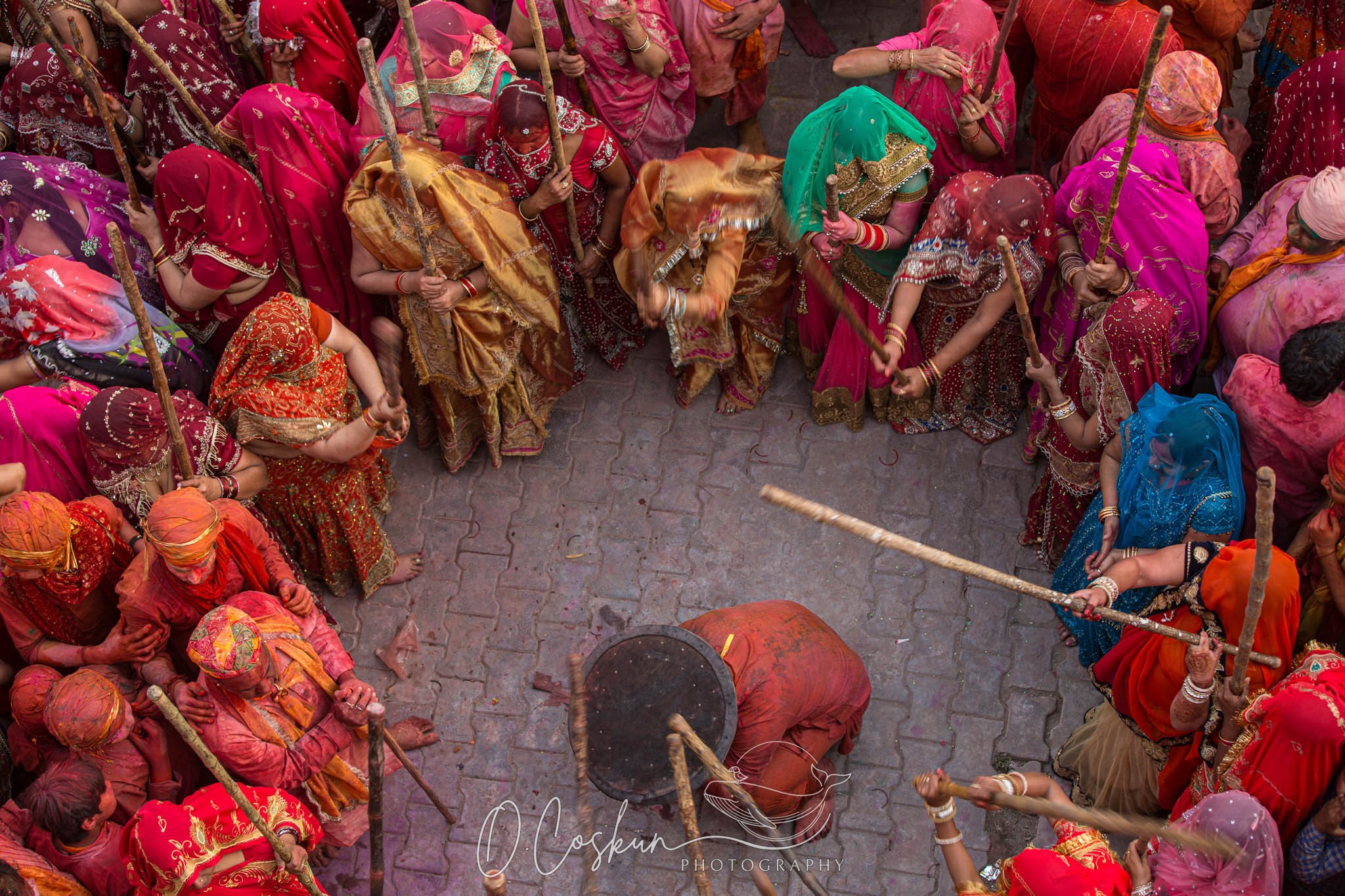
I thought I was entering some sort of block of flats; I soon realised I was actually in a house. There were people living there, who looked at me with a touch of surprise, but it didn’t bother them all that much. I was probably more surprised than they were to find myself there. The boy led me up to the terrace. A bird’s-eye view of the festivities, the crowd below, the colours rising in clouds. I was alone up there — no one else from the village had come up to look. Just me, and this view that I’d never have found if I’d been searching on my own.
What I take away from those two days isn’t the mechanics of the game — the women striking, the men defending themselves, the legend of Radha and Krishna re-enacted every year in the dust. Rather, it’s that alternation between control and its absence: in Barsana, a river that swept me away against my will, a balcony I was denied that caught up with me by surprise; in Nandgaon, a child who, without being asked, offered me the vantage point I’d been searching for in vain the day before.
I wasn’t far enough away from my subject that day. I was right in the thick of it, soaked, swallowed up by the colour — and perhaps that’s why these images matter more than the others.
*Planning Your Own Trip to Lathmar Holi
Lathmar Holi takes place in Barsana and Nandgaon a few days before the main Holi festival across India — usually in late February or early March, according to the Hindu lunar calendar (check the exact dates each year, as they shift annually). The nearest major transport hub is Mathura, reachable by train from Delhi (around 2–3 hours) or Agra (around 1.5 hours); from Mathura, Barsana and Nandgaon are roughly 45 minutes to an hour away by taxi or shared jeep, and many visitors base themselves in Mathura or Vrindavan for the festival days. Given the crowds, booking accommodation well in advance is strongly recommended.
For camera gear, prioritise protection over performance: a dedicated rain cover for cameras can save an expensive body from the coloured powder and water. A weather-sealed camera (dust- and water-resistant) paired with a single versatile, fast lens (wide aperture, to cope with the low light inside the temple) will serve better than switching between multiple lenses mid-crowd. A UV filter is worth sacrificing to protect the front element, and a shoulder strap or wrist strap is essential — both hands are rarely free. Expect the gear to need a thorough clean afterwards regardless of precautions.