A few interesting facts gleaned whilst researching the topic, for anyone who’d like to find out more.
- The scientific name, Fratercula, means ‘little brother’ — a reference to the black and white plumage, which resembles a monk’s habit.
- The puffin isn’t just clumsy when landing: it makes up for it with a remarkable fishing technique. Its beak is lined with backward-facing spines that hold the caught fish in place across its width — a documented record shows 83 small fish carried in a single beak.
- In Wales and Iceland, puffins have been observed using twigs to scratch themselves. This behaviour, previously documented only in primates and elephants, has forced researchers to revise their estimates of the species’ intelligence upwards.
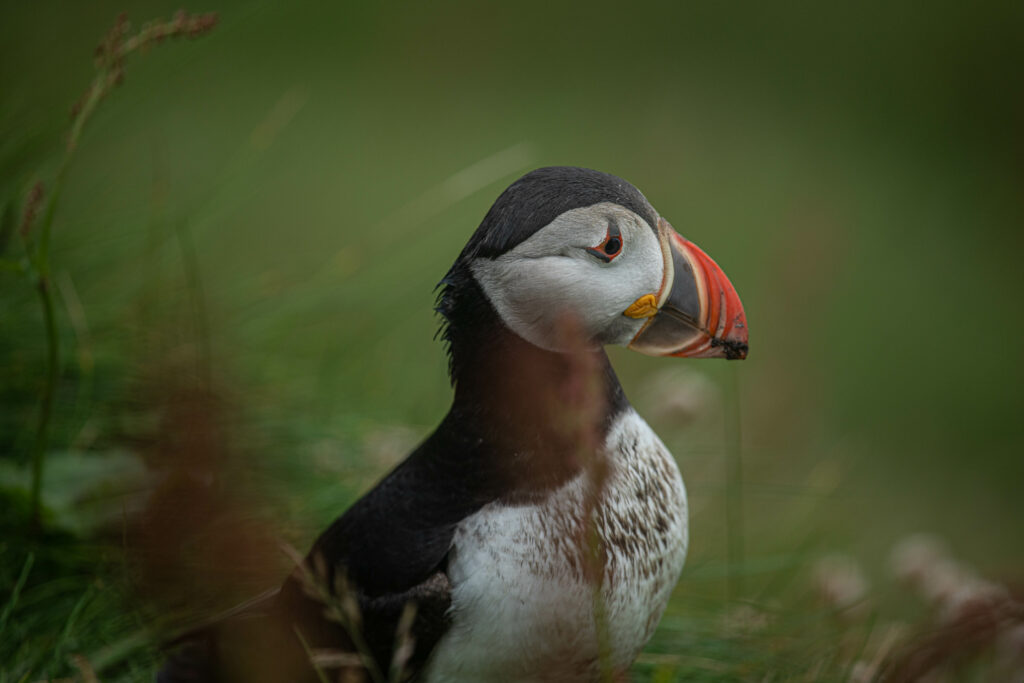
- Pairs reunite every spring at the same burrow, having spent the winter apart, scattered far and wide across the open sea. Their reunion has a name, ‘billing’: the two birds rub their beaks together, a gesture that often attracts other puffins who come to watch the scene.
- A study by the University of Oxford, conducted using geolocation data over several years, has shown that puffins do not migrate to a fixed wintering area but vary their routes from one year to the next — whilst, as individuals, remarkably faithful to their own route. Researchers believe that the bird learns its route rather than being born with it.
- On the Faroese island of Mykines, home to the country’s largest colony, the inhabitants used to pay their taxes in puffins. Today, the island’s sixteen residents no longer hunt them: they photograph them, just as I do.
- Traditional hunting in the Faroe Islands is carried out using a pole fitted with a net, known as a ‘fleygastong’: the hunter takes up a vantage point right at the heart of the colony and catches the birds in mid-flight with a single movement. An older method, which involved catching the birds directly from their burrows, has been abandoned as it was deemed unsustainable.
- The Faroese puffin population has fallen by around 70 per cent in fifty years.
- In Cornish and Welsh folklore, King Arthur’s soul is said not simply to have departed, but to have been reincarnated as a bird. The puffin is one of three contenders for this honour — alongside the raven and the red-billed chough.
- In the Middle Ages, the Catholic Church permitted only fish on Fridays. The puffin, with its black and white plumage reminiscent of a Dominican monk’s habit and its life spent at sea, was classified — rather conveniently — as ‘fish’ by the ecclesiastical authorities, which meant it could be eaten on those days despite its status as a bird.
- In Scotland, it was colloquially known as ‘Tammie Norrie’ — a name also given, in the 19th century, to a somewhat simple-minded man. The resemblance must have raised a smile.
- The puffin appears in the Snorri Edda, a 13th-century Icelandic text which codified much of Norse mythology.