It was a book that set me on the road. William Dalrymple, Nine Lives, the second chapter—a low-caste barber who becomes a god for one night on the Malabar coast. I had read that text like receiving a promise: somewhere in India there existed a ritual where the boundary between man and divine was not metaphor, but fait accompli. A man put on a costume weighing several kilos, covered himself in paint and flowers, and something else entered him.
I wanted to see that. Initial internet searches had quickly shown their limits—posted schedules, packages, organized groups. That wasn’t what I was looking for. I wanted the Theyyam of the villages, the one of the true night.
It was while searching for accommodation, almost by chance, that I found the trail. A review of a small guesthouse—three bungalows in traditional Kerala architecture, nestled near the Adi Kadalayi temple, eight kilometers south of Kannur, five minutes’ walk from Thottada beach. Run by a certain Mr. Kurian. The review’s author added, as if in passing, that Mr. Kurian knew his region perfectly—and that if one wished to attend the Theyyam festivities, he was excellent counsel. The place was called Costa Malabari.

I sent a message on WhatsApp—that’s how everything is done there. I specified that I would arrive by train, but late, past midnight. His reply came quickly, simple and calm: “Don’t worry. I have arranged a riksha to pick you up and bring you to Costa Malabari.”
I hadn’t even left yet. Someone had already thought of me.
—
The Jan Shatabdi Express—jan, the people, in Hindi. Burgundy vinyl seats, ceiling fans, blue curtains at the windows. Two hundred eighty kilometers northward, into the Kerala night. At each stop, vendors climbed into the cars with their containers of biryani, walked up the aisle offering them to travelers. India never really stops living.
It was past midnight when the train entered Kannur station. I had no idea how I would recognize the rickshaw—riksha, as Mr. Kurian said, and it had taken me a moment to understand what he was talking about. The night was pleasant, the day’s heat had withdrawn. I stepped out onto the forecourt, looked around—and he came toward me. Simply. I was the only foreigner in the night before the station. No need for a sign, no need for a name. I got in.
We crossed the deserted streets. The city slept. It was strange—I felt at once lost and unbound from everything I knew, from everything that defined me elsewhere. But there was no fear. No worry. Just that particular lightness found only at night, in an unknown city, when you’ve decided to trust.
It was Mr. Kurian’s son who welcomed me upon arrival. The night, the bungalows, the village silence—everything breathed calm. I only saw Mr. Kurian the next morning. He was there, tranquil, as if nothing had happened. A composed man, rather wise, not very talkative. He brought out his books, explained Theyyam to me with that sober precision that marks people who truly know. His wife came and went in silence—and it was she who cooked. Marvelously.
I don’t know if he’s still there.
It was he who found me Praveen Shenoy.
Praveen is a native of the region. He knows each temple, each village, each night of ceremony like others know the streets of their childhood neighborhood. Taxi driver, world-crosser—without him, I would have wandered the wrong roads to the wrong places. I called him. I asked him what the possibilities were. He answered two words: “Let me check.”
Then, a bit later: “Tomorrow we need to start at 4 o’clock morning.”
The adventure was beginning.
Praveen knew exactly where to go. We left at four in the morning—the night still thick, the roads deserted, sleeping villages scrolling past the windows. He drove without hesitation, like someone who knows every stone of the path.
I had been able to observe and photograph each stage in that small quiet room—quiet in total contrast with the agitation outside. On the ground, woven palm leaves, and in the center, a copper bowl where hands with golden bracelets, long black nails, tended a tiny flame. A humble gesture, precise, repeated. The fire had been there from the beginning, silent presence throughout the entire transformation.
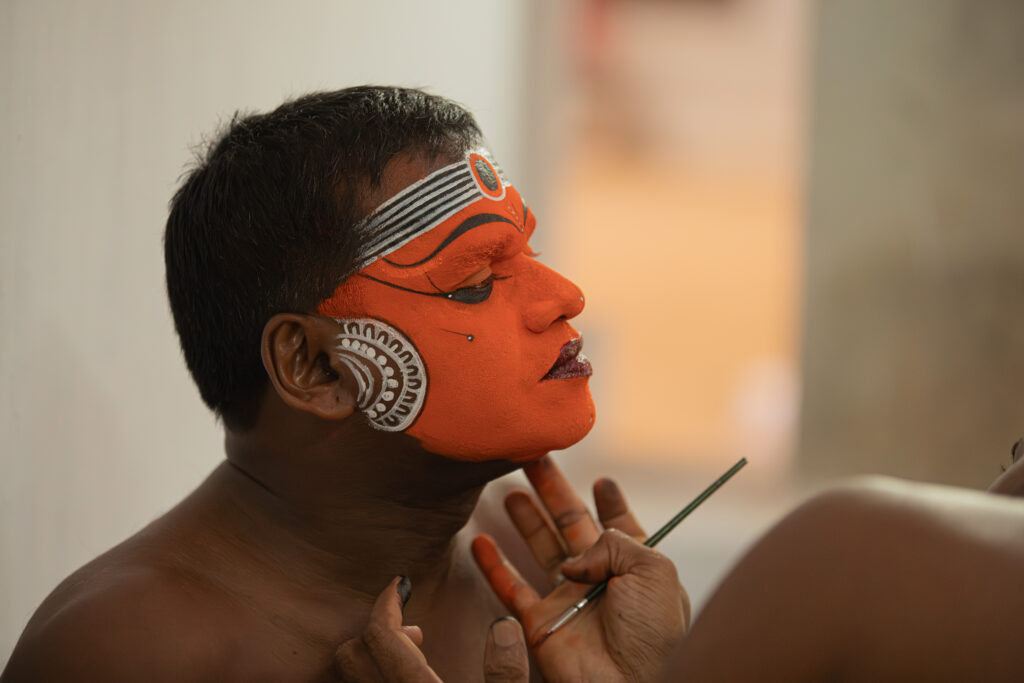
For the transformation was slow. The bare face first, then the color spreading—that bright orange that comes from turmeric, vegetal and ancient matter, not paint but something living. Then the eyes changing their gaze, the ornaments placed one by one, the monumental headdress installed last—golden, vertiginous, seeming to weigh the weight of another world.
And then, gradually, he became.
Not an apparition—a metamorphosis. It’s not a man who suddenly disappears behind a costume. It’s something that enters him slowly, in layers. At what exact moment had the man yielded his place? I couldn’t have said. Perhaps that’s the true mystery of Theyyam.
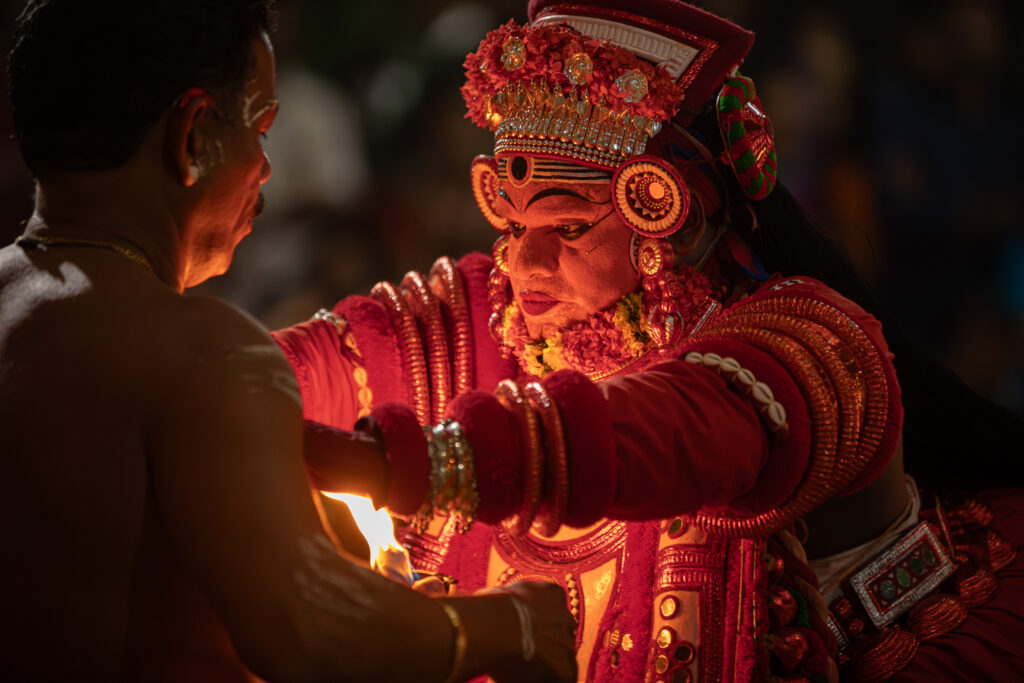
Outside, the night was inhabited. Families, villagers, children carried on shoulders. People praying. Almost no tourists—and when I met a gaze, it wasn’t the gaze placed on a burdensome stranger. It was something else. Curiosity, perhaps. Or simply benevolent indifference.
I photographed. Calmly. I was the only one doing so—no group, no flashes, no one else with a camera. They had let me enter this moment as if I were transparent. Invisible not because I was ignored, but because I had been accepted. It’s a nuance that matters.
Between two ceremonies—for it was not the only night, not the only temple—I was offered food and drink, served on a banana leaf as is customary. A simple gesture, without comment. I was the stranger, and yet I was there, within the circle.
What I retain from Theyyam is not spectacular. It’s not the monumental headdress nor the torches in the night—even if those images are there, engraved. It’s something else, simpler and stranger at once.
It’s a man lying on a mat before the temple, exhausted by the long night, while four children pressed against him look at their phones in the morning light. The millennial rite and the modern screen, without anyone finding it contradictory.
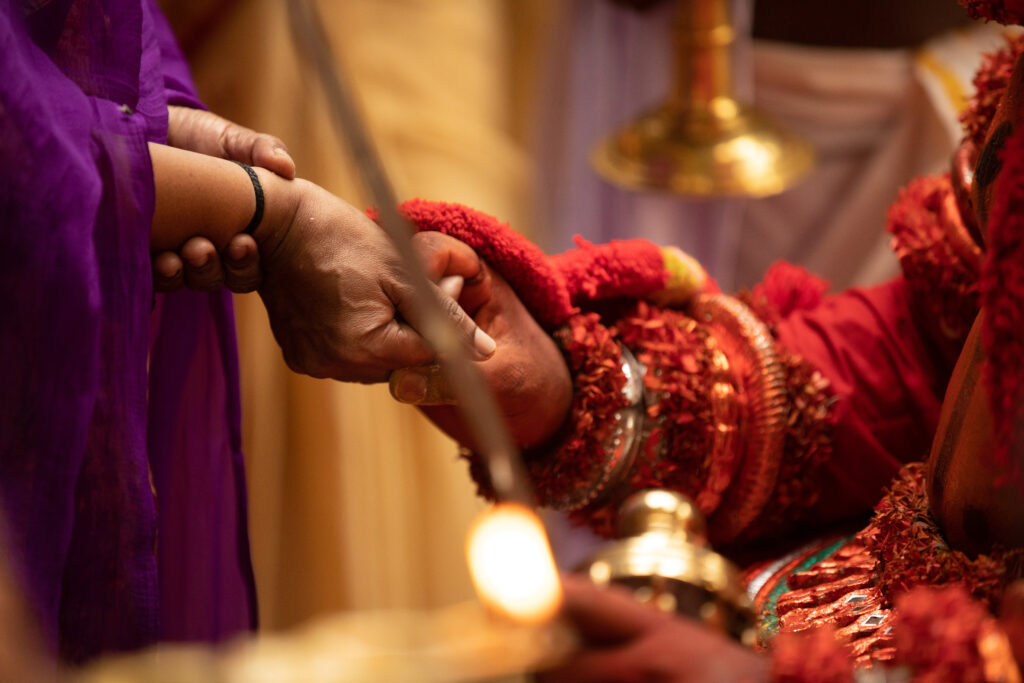
It’s a woman’s hand in a violet sari holding the hand of the divinity—adorned with red flowers, bracelets, red and gold. A tender gesture, almost banal. Except it’s not a dancer’s hand she’s holding. It’s the hand of a god.
The orange of turmeric, the flame in the copper bowl, the crowd praying in the night—all of it formed something I couldn’t name exactly. A space where the mortal becomes divinity in everyone’s eyes, and where everyone, absolutely everyone, believes it. Not as one believes in a spectacle. As one believes in something true.
I was the stranger. I didn’t share their faith. But I had been there, transparent and witness, in that Kerala night where the boundary between man and god had dissolved for the span of a dawn.
Some things don’t need to be understood to be received.