In Scotland, he was affectionately known as Tammie Norrie — a name that was also given, in the 19th century, to a rather simple-minded man.
I spent hours with them. Sitting motionless, with the camera at ground level, whilst they came and went between the cliff and the sea, never really taking any notice of my presence.
That’s the first thing that strikes you: the puffin is almost completely unafraid. You approach, you stand there, you wait — and it carries on, as if nothing were amiss, sorting through blades of grass for its burrow or gazing absently at the horizon. No frantic flight, no retreat. A confidence that, at the time, struck me as almost reckless. These birds have been nesting for generations on islands and cliffs where no land-based predator has ever threatened them — they have simply never learnt to be wary of anything that walks.
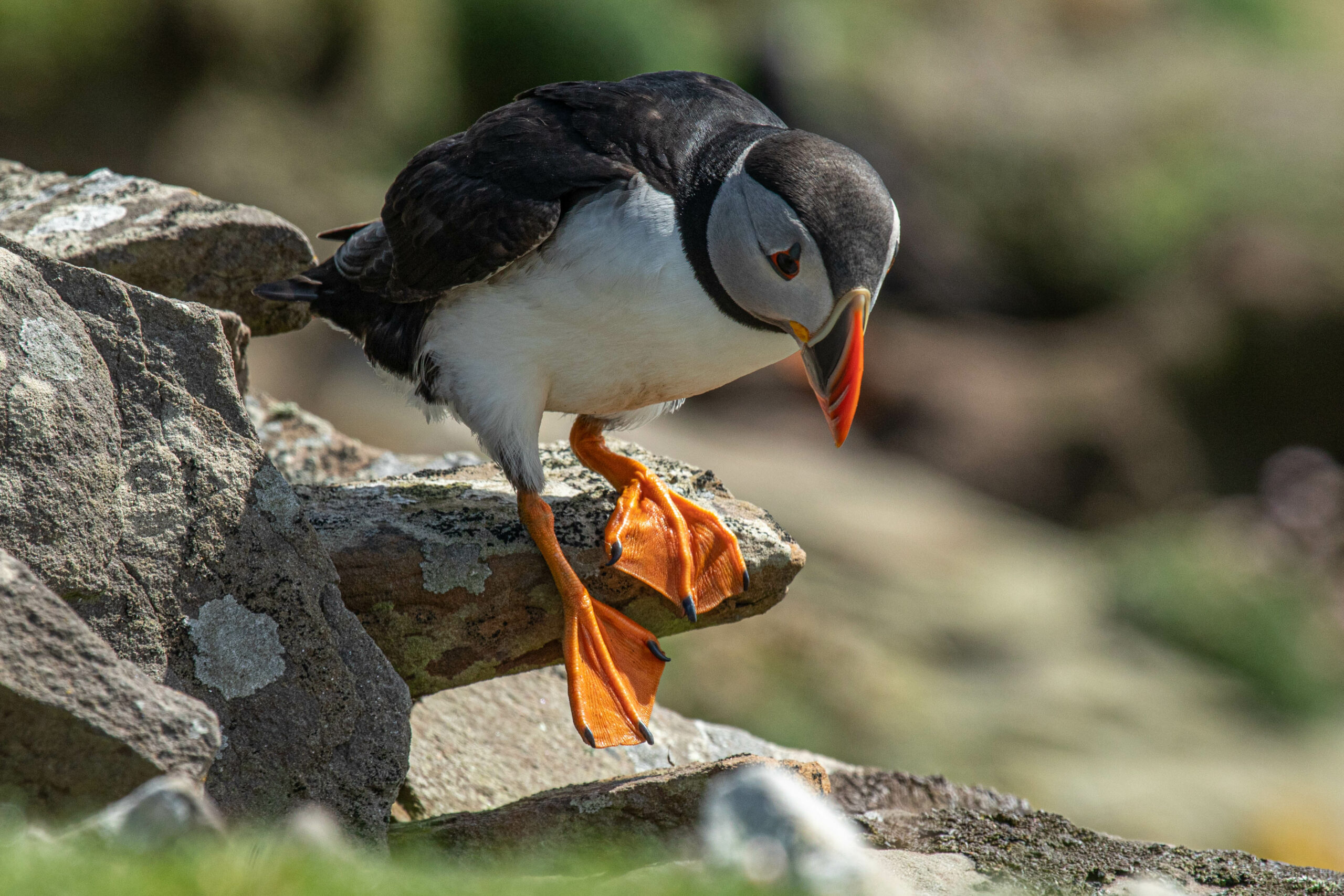
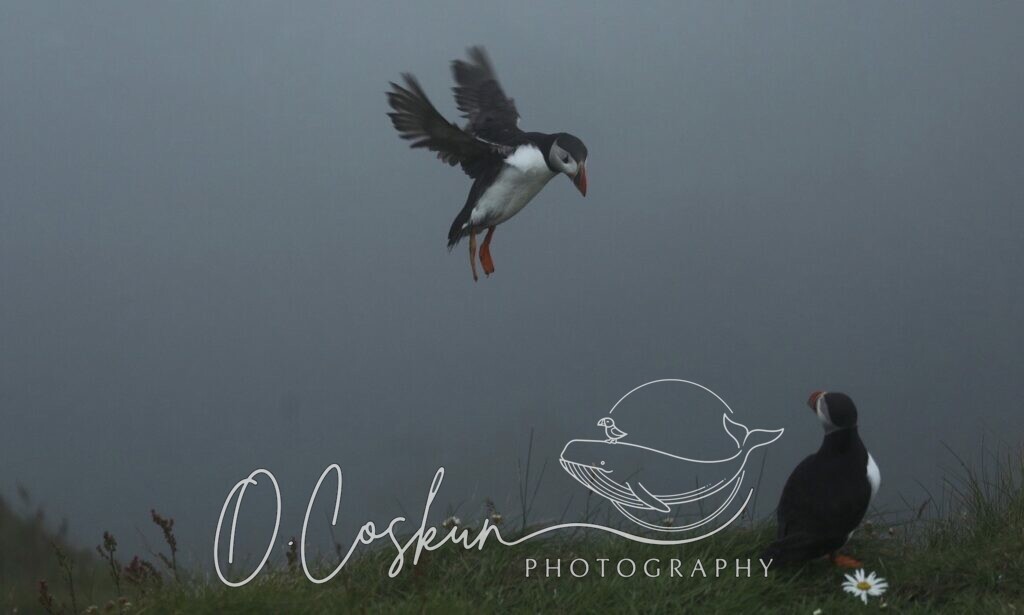
And then there’s the landing. The puffin flies well — quickly, even, flapping its small, round wings vigorously through the air. But for it, landing is a constant act of improvisation. It approaches too fast, brakes too late, bounces, regains its balance by stumbling on its orange legs, and tries again. It’s a far cry from the precision of its flight. Its wings are shaped more for swimming underwater than for gliding through the air — a compromise it pays for every time it returns to the ground. I photographed him like this for hours: this bird capable of swift flight and precise dives, yet which lands as if it were simply falling. It amuses me immensely.
It is this closeness, this total lack of wariness, that makes certain things harder to take in.
This winter, a series of storms hit the North Atlantic. Winds exceeding 150 km/h, a sea too choppy and too murky for the puffins to hunt by sight — they need clear water to spot their prey. Tens of thousands of birds have washed up on the coasts of France, Spain, Portugal and the UK. Among them were thousands of puffins, found completely drained of energy, unable to hold out until the seas calmed. Experts call this a ‘wreck’ – a mass stranding. The largest recorded in over ten years.
I think of those I watched so closely, of the trust they placed in me without a second thought, and I cannot separate the image from the figure.
There is also that video of Gordon Ramsay, filmed in the Faroe Islands, in which he is seen hunting puffins to cook their hearts. I know that hunting still takes place there – a regulated, traditional practice carried out using pole-and-net methods in the colonies – a form of hunting that is part of a culture, part of a history of subsistence on islands where people have long eaten what the cliffs provided. I haven’t come here to judge Faroese hunting as a whole, its history, or those who still practise it. But I don’t condone it. I’m not going to pretend otherwise.
But watching a man seize that particular bird — the one that lands a few metres away from you without so much as a flicker of flight, the one whose botched landing almost makes you laugh — to turn it into an ingredient of television entertainment, that’s not quite the same thing. It’s not about sustenance. Gordon Ramsay doesn’t need a puffin’s heart to eat that evening. It’s something else, which I don’t wish to elaborate on further.
I don’t have much to add to that. Just the memory of those hours spent watching them botch their landings, time and time again, without ever getting annoyed or worrying about me. I think a creature that doesn’t know how to be wary deserves a little more of our respect — and it’s on us to protect it.